
Searching Cases by Name
Sevier County does not offer a verified public trial-court name-search form. A useful name search therefore begins with the court, not with a broad surname query. The same name can appear in different courts, years, or case types. Pair names with a case number, filing year, approximate setting date, and the wording printed on the notice.
- Read the citation, summons, order, or filing and identify Circuit, General Sessions, Chancery, Juvenile, or a city court.
- Gather the full case style or party names as printed, plus the filing year and case type.
- Call or visit the responsible clerk and state whether you need the current setting, docket inspection, or a copy.
- For an appeal, open Tennessee Public Case History, choose Party Name, Case Style, or Business/Organization, and review the matching appellate case.
- Confirm the court and number before relying on a result, especially when names are common.
A clerk can help locate a public file but cannot give legal advice. Narrow identifiers reduce the chance of confusing two Sevier County cases.
Choose the Sevier County Case Clerk
The filing or citation identifies the first custodian. Circuit Court Clerk Karen Atchley maintains Circuit civil and criminal cases, including felonies bound over from General Sessions and grand-jury indictments. Circuit civil requests use (865) 453-5536 ext. 3; criminal requests use (865) 774-3731. The Circuit Court Clerk page also explains division scope and filing limits.
General Sessions Clerk Penny Johnson handles misdemeanors, traffic citations, felony preliminary hearings, civil warrants, detainers, and recovery actions. Criminal and traffic requests use (865) 453-6116; civil requests use (865) 429-5671. Chancery matters go to Clerk & Master Rylee Munson at (865) 453-4654. Juvenile matters use the Juvenile Division and special confidentiality rules. City ordinance and traffic files remain with Sevierville, Pigeon Forge, Gatlinburg, or Pittman Center city court.
Quick route: Court name plus case number is the best Sevier County search key. The title “County Clerk” does not mean that office keeps court dockets.
Sevier County Case Search Channels
Phone and counter access are the main verified trial-court routes. A narrow written request is also useful when a docket or copy cannot be resolved during a call. Include the court, case number, filing year, full style, date range, exact record sought, and whether inspection or a copy is needed. Confirm mailing or email instructions with that clerk first because the county pages do not promise one universal request form or email workflow.
Fax is not a universal search or records channel. The Circuit Court Clerk lists a surcharge and excludes many filing categories, including confidential documents and pleadings with filing fees. A fax number should not be treated as permission to send a docket request.
Searching by Case Number
A case number is more exact than a name, but no official Sevier County source published a common trial-court format. Do not rebuild or guess the code. Preserve the identifier exactly as printed, including punctuation, spaces, division marks, and leading zeros. When speaking to the clerk, read it back and name the court.
The local criminal rules use Part II and Part III for Sevier criminal administration. Those labels have real court-management meaning, but the research does not establish them as case-number prefixes. Tennessee's appellate portal accepts an appellate case number through its own search mode. It does not turn a Sevier trial number into a county docket result.
If a number fails, add the filing year, case type, party names, and last known hearing date. A missing result can reflect a typo, wrong court level, older index, or access limit rather than the absence of a case.
Sevier County Appellate Search
Tennessee Public Case History, also called C-Track, covers the Tennessee Supreme Court, Court of Appeals, and Court of Criminal Appeals. It does not search Sevier County Circuit, General Sessions, Chancery, Juvenile, or municipal dockets. An appeal creates a separate appellate case history tied back to the trial court and trial case number.
| Field or control | Type | Required | Use |
|---|---|---|---|
| Enter Search Term | Text | Not stated | Value changes with the selected search mode. |
| Case Number | Radio mode | One mode | Searches an appellate case number. |
| Case Style | Radio mode | One mode | Searches the appellate caption. |
| Party Name | Radio mode | One mode | Searches a person named in the appeal. |
| Business/Organization | Radio mode | One mode | Searches an entity named in the appeal. |
| Case Details | Result link | After results | Opens milestones, parties, history, and record details. |
The state portal explanation says the data runs through the end of the prior business day. Contact the appellate clerk for current information.
The official search form shows the actual appellate search choices.
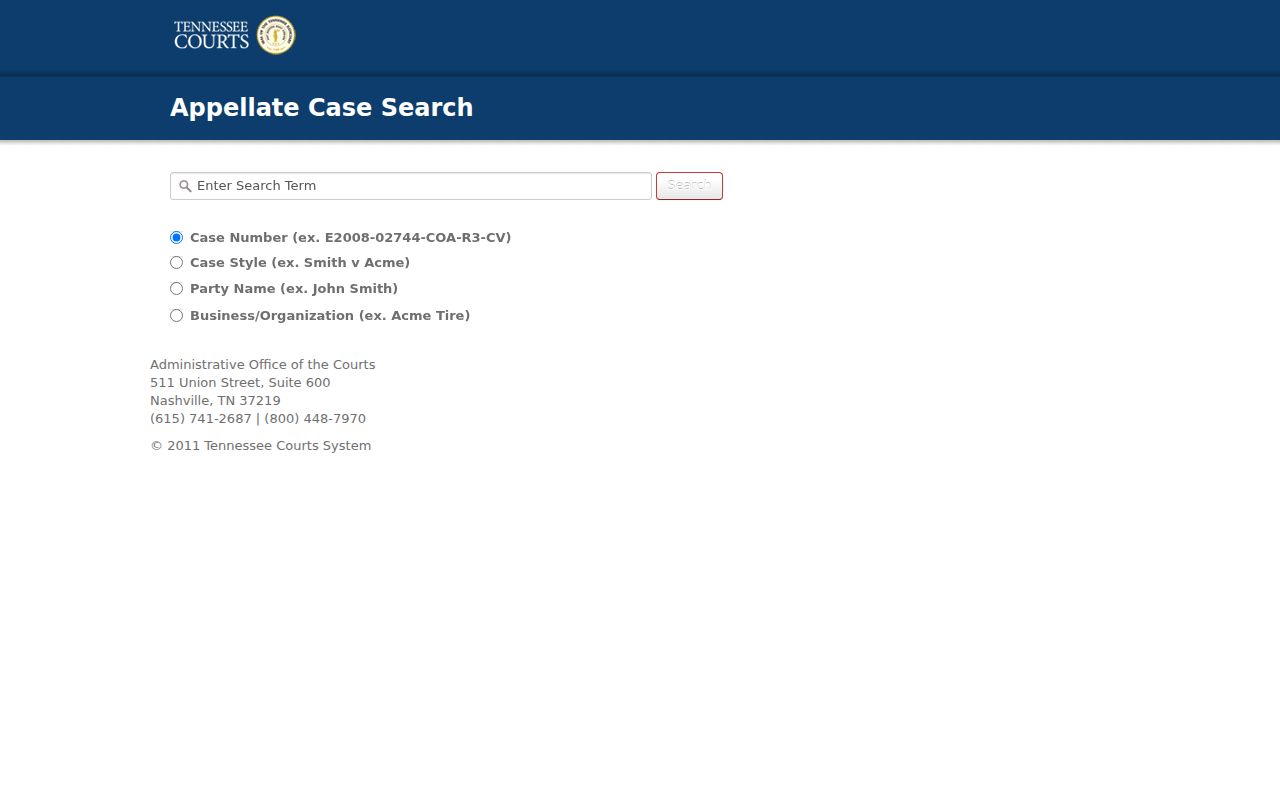
The form's statewide branding does not expand its coverage to Sevier County trial courts.
What a Case Search Returns
A Sevier County trial-court request may return a docket printout, file inspection, or copy rather than a web result. A docket is the chronological index of events. A filed document is the pleading, order, or other item behind an entry. A certified copy bears the clerk's authentication and is distinct from both.
| Case Number | The court-assigned identifier, preserved exactly from the source document. |
|---|---|
| Style or Parties | The caption and party roles, such as plaintiff, defendant, petitioner, respondent, or State. |
| Court and Case Type | The court, division or part, and criminal, civil, Chancery, juvenile, or city category. |
| Filed Date and Status | When the matter began and whether the record shows it as pending, disposed, or otherwise classified. |
| Case History | Filings, service, motions, settings, orders, judgments, resets, appeal events, and financial actions that are public. |
The public appellate detail view can also show the trial judge and number, milestone dates, counsel, document links, and record-volume information. Those observed fields are not proof that a Sevier trial file uses the same screen.
Sevier County Payment Search Limits
The county links Court Payments Online for Circuit fees and TNCRTInfo for General Sessions payments. Those routes serve payment tasks. Court Payments Online asks for state, county or city, and court, while its separate status page asks for a payment-status number. None of those fields proves that the service publishes a full docket.
Use a payment site only after matching the citation or case to the right court. A receipt or status number tracks a transaction, not every filing, setting, or disposition in the court file. The official Sevier County payment hub is useful because it separates court payment channels, but it does not replace clerk confirmation.
Note: Never infer a new court date, dismissal, or final disposition from a payment screen alone.
Sevier County Case Search Products
Ask for the product that fits the task. A docket printout shows the running list of public events. File inspection lets a reader review available pleadings and orders behind those entries. A plain copy reproduces an available page, while a certified copy adds the clerk's authentication. These choices can involve different fees and handling steps.
General Sessions publishes plain, certified, and exemplified copy charges. The Clerk & Master publishes a mail-back process for a certified divorce decree. Those office-specific examples do not create one fee schedule for every Sevier County court. Ask the custodian for the current cost before ordering.
Statewide vs County Case Search
“Statewide” describes the appellate system's geographic reach, not all Tennessee court levels. The local route is clerk based because no unified Sevier County trial portal was verified.
| Point | Tennessee Public Case History | Sevier County trial route |
|---|---|---|
| Coverage | Supreme Court, Court of Appeals, and Court of Criminal Appeals | Circuit, General Sessions, Chancery, Juvenile, and municipal files through separate clerks |
| Search method | Case number, style, party, or organization | Court, number, names, year, and case type by phone, counter, or narrow written request |
| Detail | Appellate milestones, parties, history, and available records | Public local docket, file inspection, or copies available from the custodian |
| Timing | Through the prior business day | Ask the responsible clerk for current status |
For hearing dates once the right case is located, the Sevier County court calendar routes explain which schedule source and clerk line to use.
When Sevier County Search Fails
A failed search is a routing problem until the custodian confirms otherwise. Recheck the court printed on the document. Circuit, General Sessions, Chancery, Juvenile, and city files do not share one public index. Ask whether the clerk needs the case number in a different form or can search with the year and full caption.
For older Sevier County cases, ask about bound volumes, county archives, Tennessee State Library and Archives microfilm, or the Sevier County Public Library history collection. Those sources have documented coverage for court minutes, wills, settlements, and related records. They are especially useful when a modern electronic index does not reach the requested period.
If the item remains unavailable, ask whether it is sealed, confidential, expunged, redacted, or held by another court. Request the open part or a redacted version when permitted. A written request should name the court, case number, date range, record type, inspection or copy choice, and contact information.
Sevier County City Case Search
A city name on a citation is a routing instruction. Sevierville, Pigeon Forge, Gatlinburg, and Pittman Center maintain separate municipal channels for ordinance, parking, traffic, and violation-level matters. Their public pages may show a session schedule or payment method without exposing a searchable case register.
Contact the issuing city's court clerk with the citation number and date. Ask for the current setting and public docket status. If the matter moved to General Sessions or Circuit Court, ask which new case number and custodian now apply. Do not assume the city payment page follows a transferred case.
Sevier County Search Result Timing
Public Case History covers cases after September 1, 2006 under the state's stated history range. Newer documents have broader direct access after August 26, 2013, while some older orders were migrated. The portal gives a useful public view, but its prior-business-day notice matters when a ruling or filing is recent.
The official coverage page states both the appellate limit and the update caveat.
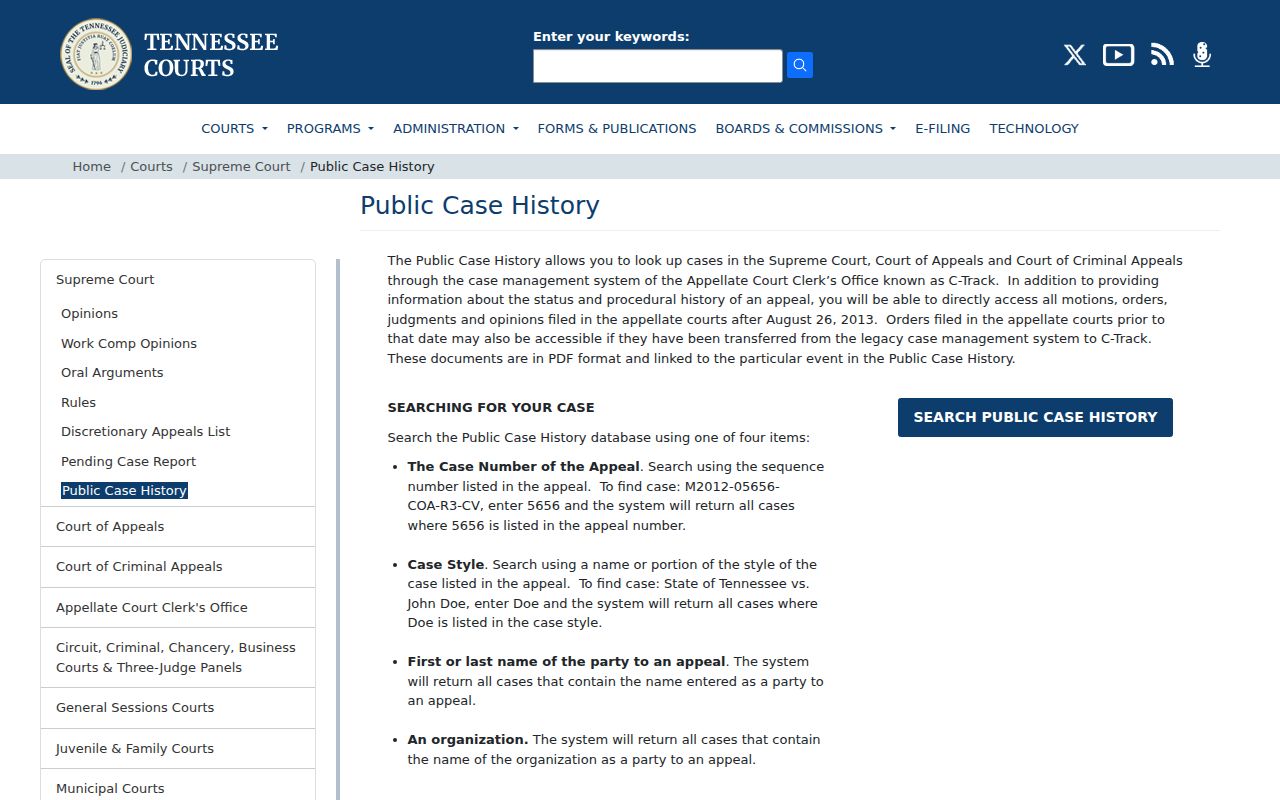
For an urgent Sevier County appeal, use the result as a lead and confirm the newest event with the appellate clerk.
Access and Restricted Cases
Tennessee Supreme Court Rule 34 generally supports inspection of public court records, subject to statutes, other rules, sealing orders, and judicial-record limits. It does not promise a free online search. Tennessee Juvenile Rule 114 imposes special confidentiality and closure standards, so an adult-style case lookup should not be expected for juvenile matters.
A sealed filing may show a limited indicator, a redacted entry, or no public result. An expunged matter may also be absent or unavailable after the order. Protected personal identifiers should be masked. “Not found” can therefore mean wrong court, wrong year, old indexing, a city file, juvenile confidentiality, a seal, or expungement.
Ask the clerk to identify the access rule or order and whether an open docket entry or redacted copy exists. Access beyond the public portion may require a party relationship, attorney authority, statutory basis, or court order. The responsible court, not an appellate or payment portal, decides that access.